Veridex
AI-Powered Phishing Detection System
Overview
Veridex is a full-stack AI cybersecurity tool that detects phishing attacks in real time. It analyzes suspicious emails, SMS messages, and URLs using a trained machine learning pipeline and returns a detailed risk report. It ships as a Web Dashboard and a Chrome Extension.
The Problem
Phishing Emails, SMS Scams (Smishing), Malicious URLs, Social Engineering, and Limited Legacy Tools make it hard to detect modern threats.
The Solution
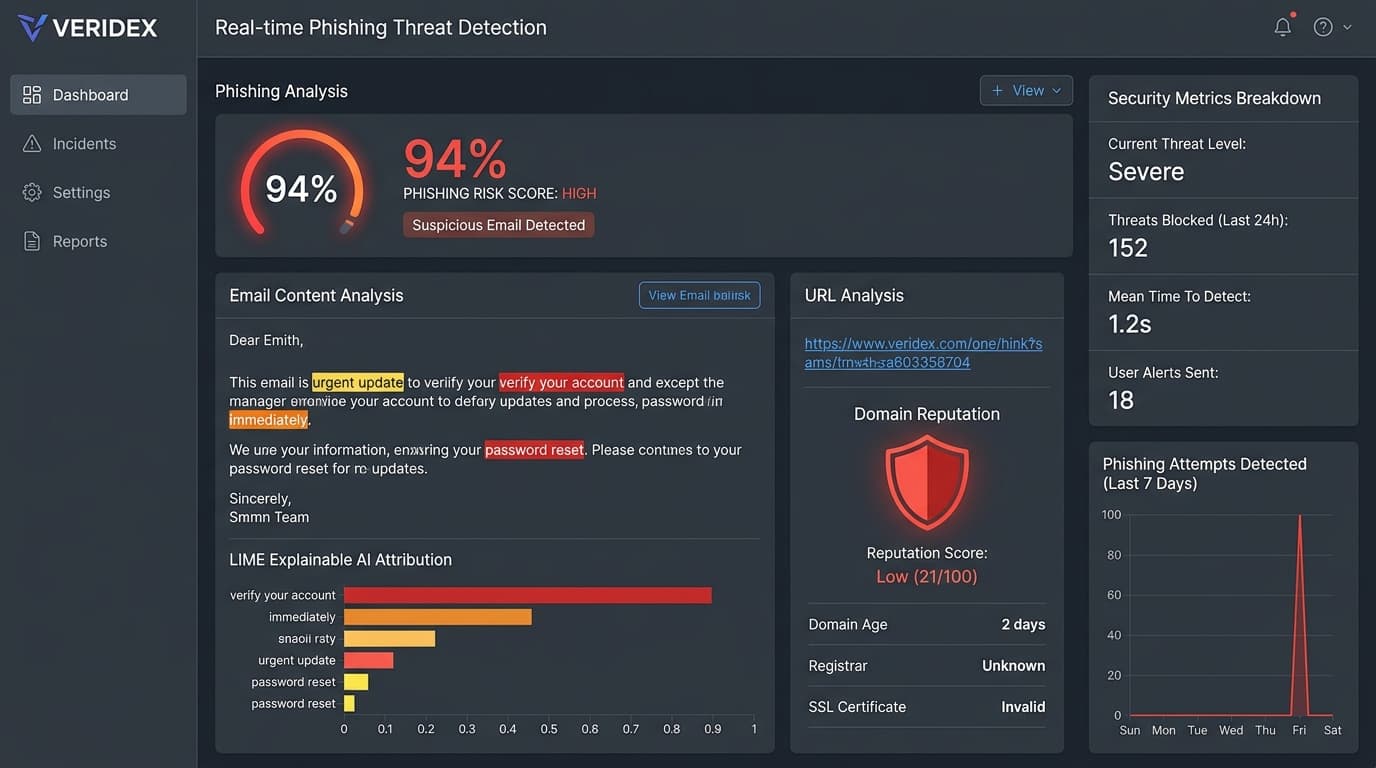
Veridex solves this by providing real-time detection directly in the browser and via a powerful web dashboard. The system combines Machine Learning (Random Forest + TF-IDF) with Deep Analysis modules and Explainable AI (XAI) using LIME.
Technology
Frontend
- React 18
- Vite
- Tailwind CSS
- Axios
Backend
- FastAPI
- Uvicorn
- Pydantic v2
- Python
AI
- scikit-learn
- TF-IDF
- LIME
Deployment
- Render
- Vercel
- Docker
Vector Ingestion
Email / SMS / DOM URL
Feature Extraction
15+ Heuristic Security Signals
Inference Core
TF-IDF + Random Forest
Explainable AI (XAI)
LIME Word Attribution
Key Capabilities
Core Detection
Email, SMS, and URL phishing detection extracting 15+ security features.
Deep Analysis
Detects social engineering tactics, categorizes threats, and scans sender domains.
Explainability (XAI)
LIME-based word-level attribution showing exactly which words pushed the model toward phishing.
Chrome Extension
Auto-scans URLs and updates a toolbar badge. Includes Gmail integration.
Obstacles Faced
- Users don't trust what they don't understand. We integrated LIME to highlight exactly which words contributed to the phishing score.
- Navigated Manifest V3 restrictions by carefully offloading heavy ML inference to the FastAPI backend while keeping the extension lightweight.
Key Takeaways
- Explainability is just as important as accuracy in cybersecurity. Providing a 'Why' is crucial for user adoption.
- Managing state and network requests inside a Manifest V3 background service worker requires robust error handling.
Future Improvements
- Expand training datasets for better zero-day phishing detection.
- Add support for more languages.
- Implement real-time threat intelligence sharing among extension users.